The addFile implementation does not rely on the SymbolTable object. With
#119294, the symbol table for input files is determined during the
construction of the objects representing them. To clarify that
relationship, this change moves the implementation from the SymbolTable
class to the LinkerDriver class.
That change forgot to set `lazy` to false before calling `addFile()` in
`forceLazy()` which caused `addFile()` to parse the file we want to
force a load for to be added as a lazy object again instead of adding
the file to `ctx.objFileInstances`.

This is caught by a pretty simple test (included).
`symtab.ctx.symtab` is just `symtab`. Looks like #119296 added
this using a global find-and-replace.

This was the only instance of `symtab.ctx.symtab` in lld/.

No behavior change.
This change prepares for hybrid ARM64X support, which requires two
`SymbolTable` instances: one for native symbols and one for EC symbols.
In such cases, `config.machine` will remain ARM64X, while the
`SymbolTable` instances will store ARM64 and ARM64EC machine types.
This change prepares for the introduction of separate hybrid namespaces.
Hybrid images will require two `SymbolTable` instances, making it
necessary to associate `InputFile` objects with the relevant one.
Inferring the ARM64EC target can lead to errors. The `-machine:arm64ec`
option may include x86_64 input files, and any valid ARM64EC input is
also valid for `-machine:arm64x`. MSVC requires an explicit `-machine`
argument with informative diagnostics; this patch adopts the same
behavior.
Since these symbols cannot be mangled or demangled, there is no symbol
to check for conflicts in `checkLazyECPair`, nor is there an alias to
create in `addUndefined`. Attempting to create an import library with
such symbols results in an error; the patch includes a test to ensure
the error is handled correctly.

This is a follow-up to #115567.
On ARM64EC, a function symbol may appear in both mangled and demangled
forms:
- ARM64EC archives contain only the mangled name, while the demangled
symbol is defined by the object file as an alias.
- x86_64 archives contain only the demangled name (the mangled name is
usually defined by an object referencing the symbol as an alias to a
guess exit thunk).
- ARM64EC import files contain both the mangled and demangled names for
thunks.

If more than one archive defines the same function, this could lead to
different libraries being used for the same function depending on how
they are referenced. Avoid this by checking if the paired symbol is
already defined before adding a symbol to the table.
On ARM64EC, external function calls emit a pair of weak-dependency
aliases: `func` to `#func` and `#func` to the `func` guess exit thunk
(instead of a single undefined `func` symbol, which would be emitted on
other targets). Allow such aliases to be overridden by lazy archive
symbols, just as we would for undefined symbols.
Co-authored-by: Billy Laws <blaws05@gmail.com>

Anti-dependency symbols are allowed to be duplicated, with the first
definition taking precedence. If a regular weak alias is present, it is
preferred over an anti-dependency definition. Chaining anti-dependencies
is not allowed.
symTab being a DenseMap, the order in which a symbol and its
corresponding import symbol are processed is not guaranteed, and when
the latter comes first, it is left undefined.
On ARM64EC, __imp_ symbols reference the auxiliary IAT, while __imp_aux_
symbols reference the regular IAT. However, x86_64 code expects both to
reference the regular IAT. This change adjusts the symbols accordingly,
matching the behavior observed in the MSVC linker.
* Don't call raw_string_ostream::flush(), which is essentially a no-op.
* Strip calls to raw_string_ostream::str(), to avoid excess layer of indirection.
In addition to the regular IAT, ARM64EC also includes an auxiliary IAT.
At runtime, the regular IAT is populated with the addresses of imported
functions, which may be x86_64 functions or the export thunks of ARM64EC
functions. The auxiliary IAT contains versions of functions that are
guaranteed to be directly callable by ARM64 code.

The linker fills the auxiliary IAT with the addresses of `__impchk_`
thunks. These thunks perform a call on the IAT address using
`__icall_helper_arm64ec` with the target address from the IAT. If the
imported function is an ARM64EC function, the OS may replace the address
in the auxiliary IAT with the address of the ARM64EC version of the
function (not its export thunk), avoiding the runtime call checker for
better performance.
These thunks can be accessed using `__impchk_*` symbols, though they
are typically not called directly. Instead, they are used to populate the
auxiliary IAT. When the imported function is x86_64 (or an ARM64EC
function with a patched export thunk), the thunk is used to call it.
Otherwise, the OS may replace the thunk at runtime with a direct
pointer to the ARM64EC function to avoid the overhead.
This implements Fast-Forward Sequences documented in ARM64EC
ABI https://learn.microsoft.com/en-us/windows/arm/arm64ec-abi.

There are two conditions when linker should generate such thunks:

- For each exported ARM64EC functions.
It applies only to ARM64EC functions (we may also have pure x64
functions, for which no thunk is needed). MSVC linker creates
`EXP+<mangled export name>` symbol in those cases that points to the
thunk and uses that symbol for the export. It's observable from the
module: it's possible to reference such symbols as I did in the test.
Note that it uses export name, not name of the symbol that's exported
(as in `foo` in `/EXPORT:foo=bar`). This implies that if the same
function is exported multiple times, it will have multiple thunks. I
followed this MSVC behavior.

- For hybrid_patchable functions.
The linker tries to generate a thunk for each undefined `EXP+*` symbol
(and such symbols are created by the compiler as a target of weak alias
from the demangled name). MSVC linker tries to find corresponding
`*$hp_target` symbol and if fails to do so, it outputs a cryptic error
like `LINK : fatal error LNK1000: Internal error during
IMAGE::BuildImage`. I just skip generating the thunk in such case (which
causes undefined reference error). MSVC linker additionally checks that
the symbol complex type is a function (see also #102898). We generally
don't do such checks in LLD, so I made it less strict. It should be
fine: if it's some data symbol, it will not have `$hp_target` symbol, so
we will skip it anyway.
SmallPtrSet.h and TimeProfiler.h are unused. CommandLine.h is only
needed for the UseNewDbgInfoFormat declare, which can be moved to the
places that need it.
For x86_64 callable functions, ARM64EC requires an entry thunk generated
by the compiler. The linker interprets .hybmp sections to associate
function chunks with their entry points and writes an offset to thunks
preceding function section contents.

Additionally, ICF needs to be aware of entry thunks to not consider
chunks to be equal when they have different entry thunks, and GC needs
to mark entry thunks together with function chunks.

I used a new SectionChunkEC class instead of storing entry thunks in
SectionChunk, following the guideline to keep SectionChunk as compact as
possible. This way, there is no memory usage increase on non-EC targets.
Commit b963c0b658 fixed LTO compilation of
cases where one translation unit is calling a function with the
dllimport attribute, and another translation unit provides this function
locally within the same linked module (i.e. not actually dllimported);
see https://github.com/llvm/llvm-project/issues/37453 or
https://bugs.llvm.org/show_bug.cgi?id=38105 for full context.

This was fixed by aliasing their GlobalResolution structs, for the
`__imp_` prefixed and non prefixed symbols.

I believe this fix to be wrong.

This patch reverts that fix, and fixes the same issue differently,
within LLD instead.

The fix assumed that one can treat the `__imp_` prefixed and unprefixed
symbols as equal, referencing SVN r240620
(d766653534). However that referenced
commit had mistaken how this logic works, which was corrected later in
SVN r240622 (88e0f9206b); those symbols
aren't direct aliases for each other - but if there's a need for the
`__imp_` prefixed one and the other one exists, the `__imp_` prefixed
one is created, as a pointer to the other one.

However this fix only works if both translation units are compiled as
LTO; if the caller is compiled as a regular object file and the callee
is compiled as LTO, the fix fails, as the LTO compilation doesn't know
that the unprefixed symbol is needed.

The only level that knows of the potential relationship between the
`__imp_` prefixed and unprefixed symbol, across regular and bitcode
object files, is LLD itself.

Therefore, revert the original fix from
b963c0b658, and fix the issue differently
- when concluding that we can fulfill an undefined symbol starting with
`__imp_`, mark the corresponding non prefixed symbol as used in a
regular object for the LTO compilation, to make sure that this non
prefixed symbol exists after the LTO compilation, to let LLD do the
fixup of the local import.

Extend the testcase to test a regular object file calling an LTO object
file, which previously failed.

This change also fixes another issue; an object file can provide both
unprefixed and prefixed versions of the same symbol, like this:

    void importedFunc(void) {
    }
    void (*__imp_importedFunc)(void) = importedFunc;

That allows the function to be called both with and without dllimport
markings. (The concept of automatically resolving a reference to
`__imp_func` to a locally defined `func` only is done in MSVC style
linkers, but not in GNU ld, therefore MinGW mode code often uses this
construct.)

Previously, the aliasing of global resolutions at the LTO level would
trigger a failed assert with "Multiple prevailing defs are not allowed"
for this case, as both `importedFunc` and `__imp_importedFunc` could be
prevailing. Add a case to the existing LLD test case lto-imp-prefix.ll
to test this as well.

This change (together with previous change in
3ab6209a3f) completes LLD to work with
mingw-w64-crt files (the base glue code for a mingw-w64 toolchain) built
with LTO.
Normally, this shouldn't happen. It can happen in exceptional
circumstances, if the compiled output of a bitcode object file
references symbols that weren't listed as undefined in the bitcode
object file itself.

This can at least happen in the following cases:
- A custom SEH personality is set via asm()
- Compiler generated calls to builtin helper functions, such as
__chkstk, or __rt_sdiv on arm

Both of these produce undefined references to symbols after compiling to
a regular object file, that aren't visible on the level of the IR object
file.

This is only an issue if the referenced symbols are provided as LTO
objects themselves; loading regular object files after the LTO
compilation works fine.

Custom SEH personalities are rare, but one CRT startup file in mingw-w64
does this. The referenced pesonality function is usually provided via an
import library, but for WinStore targets, a local dummy reimplementation
in C is used, which can be an LTO object.

Generated calls to builtins is very common, but the builtins aren't
usually provided as LTO objects (compiler-rt's builtins explicitly pass
-fno-lto when building), and many of the builtins are provided as raw .S
assembly files, which don't get built as LTO objects anyway, even if
built with -flto.

If hitting this unusual, but possible, situation, error out cleanly with
a clear message rather than crashing.
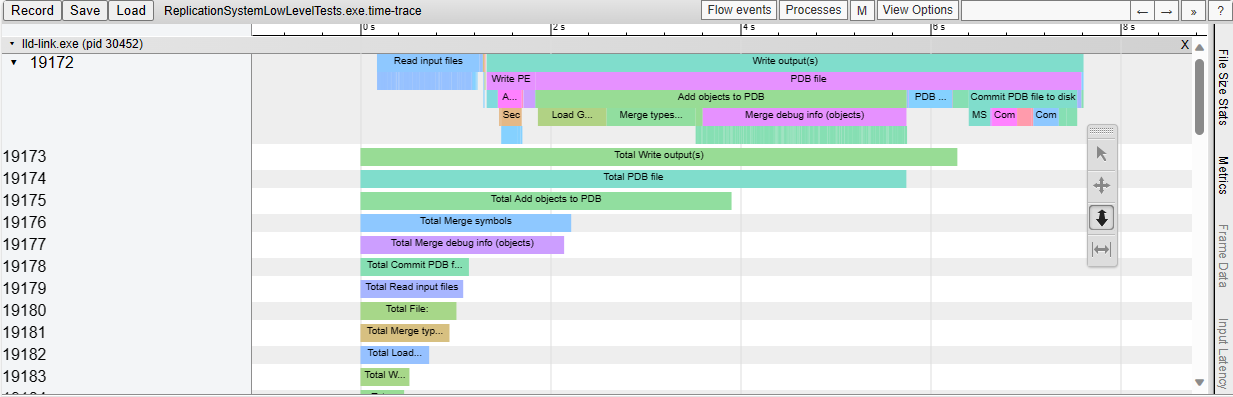
This adds support for generating Chrome-tracing .json profile traces in
the LLD COFF driver.
Also add the necessary time scopes, so that the profile trace shows in
great detail which tasks are executed.
As an example, this is what we see when linking a Unreal Engine
executable:
This reverts commit 7370ff624d.
(and 47fb8ae2f9).

This commit broke the symbol type in import libraries generated
for mingw autoexported symbols, when the source files were built
with LTO. I'll commit a testcase that showcases this issue after
the revert.
We were previously ignoring weak externals during these searches (which
are used for the entry point, exports, and subsystem inference), which
differed from link.exe behavior. It also meant that we could get
different behavior when linking an object file directly vs. packaging it
into a static library, because static library symbol name directories
include weak externals.

Reviewed By: mstorsjo, yozhu

Differential Revision: https://reviews.llvm.org/D139764
LLVM bitcode contains support for weak symbols, so we can add support
for overriding weak symbols in the output COFF even though COFF doesn't
have inherent support for weak symbols.

The motivation for this patch is that Chromium is trying to use libc++'s
assertion handler mechanism, which relies on weak symbols [0], but we're
unable to perform a ThinLTO build on Windows due to this problem [1].

[0]: https://reviews.llvm.org/D121478
[1]: https://crrev.com/c/3863576

Reviewed By: rnk

Differential Revision: https://reviews.llvm.org/D133165
This relands 73e585e44d (and 0574b5fc65), with a fix for
the failing test (by using Optional<StringRef>s instead of
making StringRef::empty() mean absence of value).

Differential Revision: https://reviews.llvm.org/D118070


